
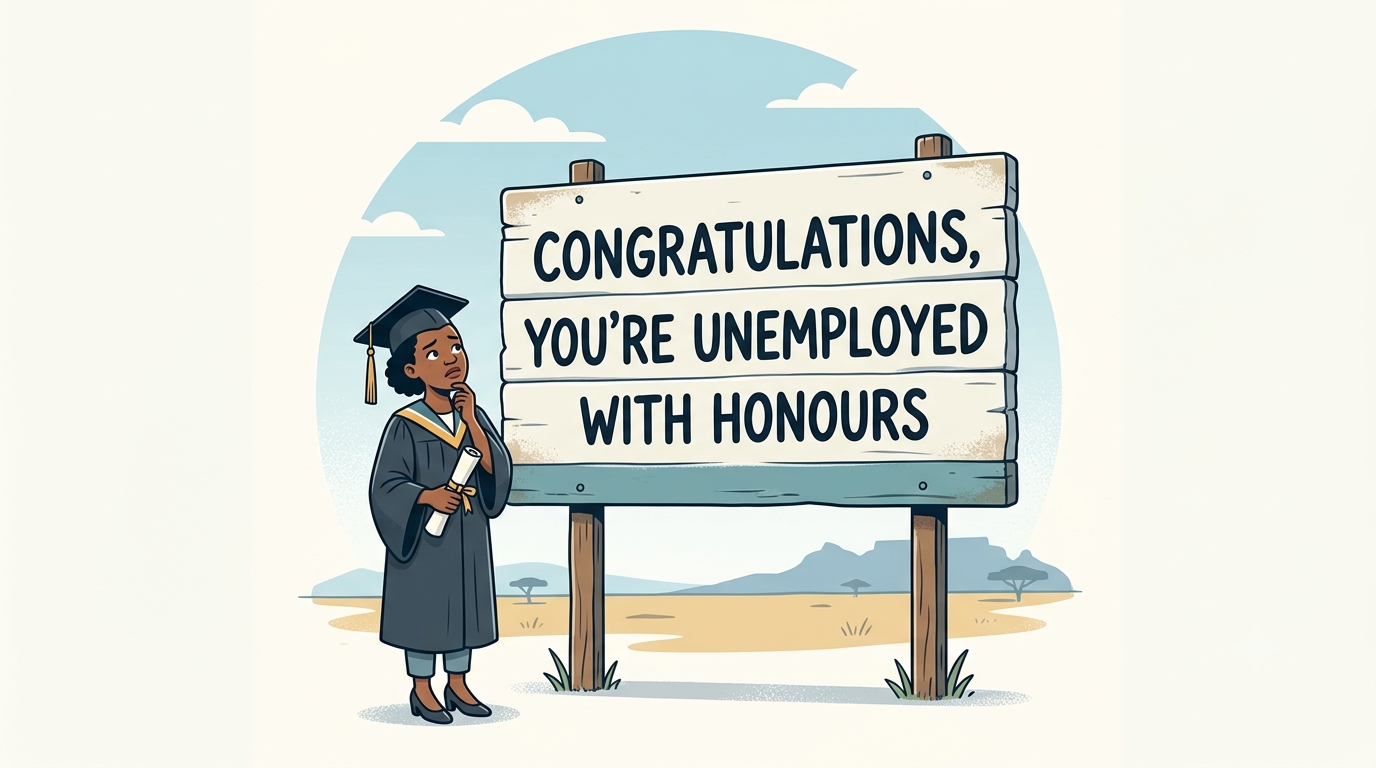
Congratulations, You're Unemployed With Honours
You did it. Four (or five, or "it's complicated") years of lectures, deadlines, instant noodles, and a graduation gown that made you sweat in ways no fabric should. You have the certificate. You have the photos in the cap and gown, squinting into the sun, holding a rolled-up piece of paper like it's a trophy.
Now what?
For a growing number of graduates, "now what" is a long, quiet stretch of job applications disappearing into the void, second-guessing that degree choice, and explaining to relatives at every family gathering that no, you have not "found something yet."
Here's an uncomfortable question: what if your qualification was never designed to guarantee you a job in the first place?
Wait, Isn't That the Whole Point of University?
Good question. You'd think so. You paid the fees (or your loan did, bless it), you sat the exams, you did the group projects where one person did all the work. Surely the finish line is a job?
Not quite. Most degrees are built to teach you a subject. Accounting teaches you accounting. Journalism teaches you journalism. What almost none of them teach you is what to do when the job market shrugs at your CV and says, "Thanks, but we need someone with experience... for this entry-level role."
That's the gap. And it's a gap that a single elective on "how to build something of your own" could actually help close.
So Your Big Idea Is... More Classes?
Kind of. Hear us out.
Imagine if, alongside "Introduction to Microeconomics" or "Organic Chemistry II," every student; regardless of major;had to take one practical course: How to Create Value When Nobody Hands You a Job.
Not a theory-heavy, PowerPoint-till-you-cry lecture series. An actual, hands-on course covering:
- - How to spot a problem worth solving (hint: it's usually one that annoys you personally)
- - How to pitch an idea without sounding like a late-night infomercial
- - Basic budgeting, so "profit" doesn't come as a surprise concept at 25
- - How to sell — yourself, a service, a product — without wanting to disappear into the floor
- - How to build something small on the side while still job-hunting
Q: But I'm studying medicine / engineering / law. Why would I need this? A: Because "I have a stable, well-paid profession lined up" is not guaranteed just because your course sounds serious. Doctors open private practices. Engineers start consultancies. Lawyers freelance. Even the "safe" degrees eventually meet the real world, and the real world doesn't care how hard your final exam was.
"But Claude, Entrepreneurship Can't Be Taught!"
Sure, and neither can public speaking, negotiation, or how to not panic during a live interview — yet somehow we still teach those.
Nobody's claiming a course turns every graduate into the next big founder story. That's not the goal. The goal is simpler: give people a Plan B that isn't panic.
Right now, the unofficial Plan B for most unemployed graduates is:
- Apply to everything
- Feel bad
- Consider a completely unrelated online course
- Ask if the family business is hiring
- Repeat
A basic grounding in entrepreneurial thinking turns that Plan B into something with actual structure — spotting a gap, testing a small idea, learning to generate income while still hunting for that "real job."
What This Actually Looks Like in Practice
Q: Okay, I'm listening. What would this course even cover in real terms? A: Think less "start a unicorn startup" and more "start a functioning small income stream." Practical modules might include:
- - Turning a skill you already have into a paid service (yes, that thing you're "just okay" at someone will pay for it)
- - Understanding basic contracts and pricing, so you don't undercharge out of fear
- - Digital basics: setting up a simple online presence, because "I'll figure it out later" is not a strategy
- - Handling rejection, from clients, investors, or the market — without it becoming a personality trait
Q: Isn't this just extra pressure on students who are already drowning in coursework? A: Fair point. But it's less pressure than graduating with zero backup plan and a CV that reads like everyone else's CV. One practical module is a lighter lift than the multi-year identity crisis that tends to follow prolonged unemployment.
The numbers back this up. In the US, the underemployment rate for recent college graduates, meaning graduates working jobs that don't actually require a degree, has climbed to around 42%, the highest level since 2020 according to a Federal Reserve Bank of New York study covering 73 college majors. Even more telling, entry-level job postings aimed at graduates dropped sharply, with campus-focused job listings on Handshake falling 15 to 16% year-over-year while applications per posting climbed 26 to 30%, a brutal ratio of more competition chasing fewer openings. It's not just a US story either: the International Labour Organization estimated over 73 million young people aged 15–24 were unemployed globally, most of them graduates from higher education institutions, and researchers increasingly point to a structural mismatch, the World Bank has flagged the skills gap between what the job market needs and what university curricula actually teach as a real obstacle to graduate employment. On the flip side, the case for entrepreneurship education isn't just wishful thinking: a 2024 study on Soran University graduates found a significant positive correlation between entrepreneurship and reduced unemployment, with entrepreneurship education and access to funding playing a pivotal role in helping graduates create their own opportunities. So no — this isn't just a hot take. It's a documented, global, thoroughly researched mess. Forbes + 4
References:
- Federal Reserve Bank of New York, The Labor Market for Recent College Graduates (2026) — newyorkfed.org/collegelabor
- Forbes, Unemployment And Underemployment Rates Among Recent College Graduates (Feb 2026) — forbes.com
- AcademicJobs, Rising Unemployment Among Recent US College Graduates (2026) — academicjobs.com
- Salih, E.Sh., Ahmed, W.K., Kawkas, O.M., The impact of entrepreneurship dimensions on solving unemployment problems among Soran University Graduate Students (2024), Economics, Entrepreneurship, Management — doi.org/10.56318/eem2024.01.008
- Promoting Entrepreneurship to Reduce Graduate Unemployment (citing ILO 2019 estimates and World Bank 2020 findings) — mountkenya.academia.edu
The Bottom Line
A university qualification should open doors. But when the job market decides to keep half those doors locked, graduates deserve more than a certificate and a "good luck out there."
Teaching entrepreneurial thinking alongside every degree isn't about turning every student into a founder. It's about making sure that when the job offers don't come, and for a lot of graduates, they won't, at least not immediately, there's a real, taught, practiced alternative on hand instead of blind panic and a very long scroll through job boards.
Because "I have a degree" should never have to sit next to "and no idea what to do next."
Looking for your next opportunity? or ready to build your own? Explore what's out there on WorkBase21.