Is a University Degree Still Worth It in This Age and Time?
For generations, going to university has been presented as one of the clearest paths to a successful career. Finish high school, go to university, earn a degree and find a good job. That formula has worked for many people, but the world of work is changing quickly.
Today, students have more options than previous generations. Online courses, professional certifications, apprenticeships, coding bootcamps, entrepreneurship and practical training can all provide valuable skills. At the same time, artificial intelligence and changing employer expectations have made people question whether spending several years at university is still necessary.
So, is a university degree still worth it?
The answer is yes for many people, but not necessarily for everyone.
A degree is still valuable, but its value depends heavily on what you study, why you are studying it, the career you want to pursue and what you do with the qualification after graduating.
Some Careers Still Require a Degree
The most obvious reason university remains important is that certain careers require formal qualifications.
If you want to become a doctor, lawyer, engineer, teacher, accountant or enter certain scientific and professional careers, a university qualification may be an essential part of the pathway.
In these fields, you cannot simply replace years of formal education with a few online courses and expect to meet the professional requirements.
Medicine is a good example. You need extensive education and practical training before you can practise as a doctor. The same principle applies to many regulated professions.
For students interested in these careers, asking whether university is worth it is almost beside the point. The qualification is part of the profession.
A Degree Can Open Doors
Even in industries where a degree is not strictly required, having one can still open doors.
Many employers use qualifications as one way of screening candidates. When hundreds of people apply for the same position, a degree can demonstrate that you have completed a structured programme of study and developed knowledge in a particular field.
This does not mean that a degree guarantees employment.
It simply means that having the qualification can help you qualify for opportunities that might otherwise be unavailable.
For a graduate applying for a job that specifically asks for a bachelor's degree, someone without that qualification may be eliminated before their other skills are even considered.
But a Degree Does Not Guarantee a Job
This is where the conversation becomes more complicated.
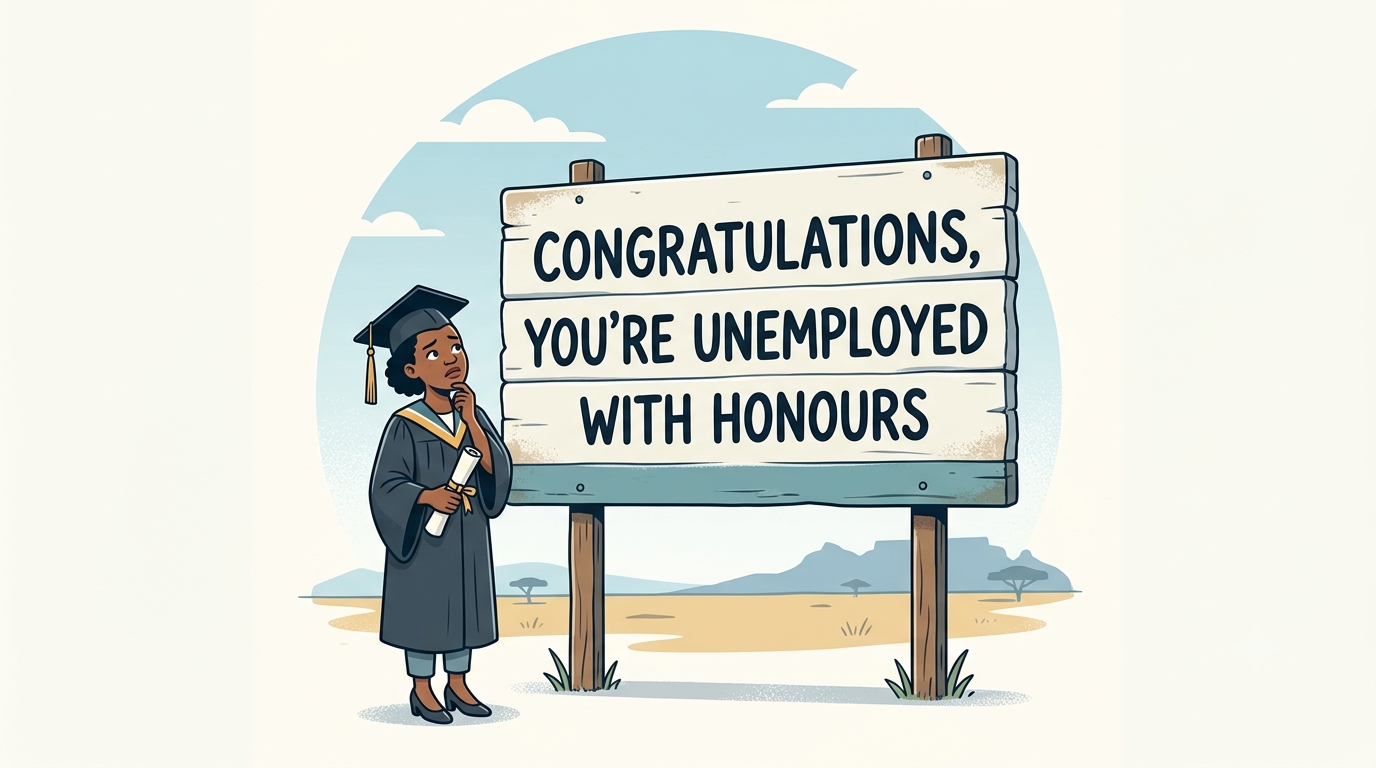
A university degree is not a job guarantee.
A person can graduate with a qualification and still struggle to find employment. This is particularly relevant in countries such as South Africa, where competition for employment can be extremely high.
Thousands of graduates enter the labour market looking for opportunities every year, and there may not be enough suitable positions available for everyone.
This means students should not approach university with the assumption that simply receiving a degree will automatically result in a well-paying job.
A degree can improve your opportunities, but it does not remove the need to build experience, develop skills and actively pursue opportunities.
What You Study Matters
Not all degrees lead to the same career opportunities.
This does not mean that some degrees are "good" and others are "bad." Different fields serve different purposes.
However, students should understand the relationship between their chosen qualification and the careers they are interested in.
Before choosing a degree, ask yourself what people with that qualification actually do after graduating.
Research the types of jobs available, the skills employers request, the typical career paths and whether further study is required.
Choosing a qualification simply because someone told you it is prestigious can be a risky decision.
Choose with information rather than pressure.
The Cost of University Matters
Another important question is how much the degree will cost compared with the opportunities it can create.
University is an investment of both time and money.
Students may have tuition costs, accommodation expenses, transport costs, textbooks and other expenses. Some may also graduate with debt.
This does not mean that university is a bad investment. It means that students should think carefully about the financial side of their decision.
A degree that leads to strong career opportunities may be a very worthwhile investment.
But students should avoid choosing an expensive programme simply because they believe having any degree is better than having none.
Research the programme, institution, career opportunities and financial implications before making the decision.
Experience Has Become Extremely Important
One of the biggest changes in the modern job market is the importance of practical experience.
Employers do not always want someone who only knows the theory. They often want someone who can apply what they have learned.
This is why students should try to gain practical experience while studying.
Internships, vacation work, volunteering, student organisations, freelance projects, university projects and part-time work can all help develop practical skills.
For example, a computer science student can build software projects. A marketing student can create a portfolio of campaigns. A finance student can gain experience with financial analysis. A journalism student can build a portfolio of published work.
Your degree tells an employer what you studied.
Your experience can show them what you can actually do.
Skills Can Sometimes Matter More Than the Degree
There are industries where practical skills can be more important than having a specific university qualification.
Technology is a good example.
Someone interested in web development, software development or certain digital careers can learn valuable skills through a combination of formal education, online resources, practical projects and experience.
A university graduate may have an advantage in certain situations, but someone without a degree who has an impressive portfolio and strong technical skills may still be able to find opportunities.
The same principle can apply to areas such as digital marketing, graphic design, content creation and some forms of entrepreneurship.
This does not make university irrelevant.
It means that the path to employment is becoming more diverse.
Online Learning Has Changed Education
Learning is no longer limited to a university classroom.
Today, people can learn programming, data analysis, design, marketing, cybersecurity, artificial intelligence and countless other skills through online courses and educational platforms.
This is a major advantage for people who cannot afford or do not have access to traditional university education.
However, online learning also has limitations.
Completing an online course does not automatically give you the same recognition as a university degree in every industry. Employers may also care about the quality of the course and whether you can demonstrate what you learned.
The strongest approach is often to combine learning with practical application.
Don't just collect certificates.
Build things. Solve problems. Create a portfolio. Gain experience.
Artificial Intelligence Is Changing the Equation
AI has made the question about university even more interesting.
AI tools can help people learn concepts, write code, analyse information, generate ideas and complete many tasks that previously required significant amounts of time.
This may lead some people to believe that formal education is becoming unnecessary.
But AI does not eliminate the value of understanding the fundamentals.
If you use AI to generate code without understanding programming, for example, you may struggle when the code does not work or when you need to make an important technical decision.
The same applies to other professions.
AI can help you work faster, but knowledge allows you to evaluate whether the output is actually useful or correct.
This means the future may favour people who combine education with technology rather than people who choose one and ignore the other.
Employers Want More Than Qualifications
A degree can get your application considered, but employers may look for much more than your qualification.
They may want communication skills, problem-solving ability, teamwork, adaptability, technical knowledge and practical experience.
This is why two graduates with the same degree can have very different employment outcomes.
One may have spent their university years only attending classes and passing exams.
Another may have completed internships, built projects, developed professional connections, volunteered and learned additional skills.
They both have the same qualification.
But they may not have the same level of preparation for the workplace.
University Can Also Develop More Than Technical Skills
There is another benefit of university that is sometimes overlooked.
University can help students develop independence, discipline, research skills, critical thinking and the ability to work with people from different backgrounds.
Students are often required to manage deadlines, complete difficult assignments, present ideas and solve problems without having someone constantly telling them what to do.
These experiences can be valuable beyond the classroom.
The university experience can therefore provide more than a certificate.
However, students need to actively participate in that experience to get the most from it.
University Is Not the Only Path to Success
It is important to make one thing clear: not going to university does not mean that someone cannot build a successful career.
There are many careers where vocational training, apprenticeships, professional certifications, entrepreneurship or practical experience can provide an excellent pathway.
Electricians, plumbers, mechanics, technicians, artisans, entrepreneurs and many other professionals can build successful careers without following a traditional university route.
The important question is not whether university is the only path.
It isn't.
The question is which path makes the most sense for your goals.
What About Young People Who Are Unsure?
If you are finishing school and have no idea what career you want, do not choose a degree simply because you feel pressured to make a decision.
Take time to research different careers.
Talk to people who actually work in those industries. Look at job advertisements. Find out what qualifications employers require. Consider the cost and length of the training.
You can also explore introductory courses or projects to determine whether you actually enjoy a particular field.
Making an informed decision at the beginning can save you years of frustration later.
How to Make Your Degree More Valuable
If you decide to attend university, don't treat your degree as the finish line.
Treat it as a foundation.
While studying, develop practical skills. Build projects. Look for internships. Attend career events. Create a professional online profile. Network with people in your industry.
Learn tools that employers actually use.
If you are studying computer science, learn technologies used in the industry and build software.
If you are studying finance, become comfortable with relevant financial and analytical tools.
If you are studying marketing, develop a portfolio.
Whatever you study, try to answer one question:
What can I actually do with what I have learned?
That question can make a huge difference when you graduate.
The Degree Plus Skills Combination
Perhaps the best way to think about university in today's job market is not as a choice between a degree and skills.
You can have both.
A degree can provide structured knowledge and open certain doors, while practical skills and experience can help you compete once you get through those doors.
Imagine two candidates applying for the same position.
One has a relevant degree but little practical experience.
The other has the same degree, an internship, several projects and additional technical skills.
The second candidate may have a stronger application because they can demonstrate how they have applied their education.
The combination is powerful.
So, Is a University Degree Still Worth It?
For many people, yes.
But a university degree should not be viewed as a guaranteed ticket to employment.
Its value depends on the career you want, the qualification you choose, the institution you attend, the cost involved and what you do alongside your studies.
For regulated professions, a degree may be essential.
For other careers, there may be alternative pathways that are faster, cheaper or more practical.
The mistake is thinking that there is one correct path for everyone.
Final Thoughts
The world of work has changed significantly, and education is changing with it.
A university degree still has value. It can provide knowledge, credibility, professional opportunities and access to careers that require formal qualifications.
But the modern job market also rewards practical experience, adaptability, digital skills, communication and continuous learning.
The smartest approach is therefore not to ask whether university is completely worth it or completely outdated.
Ask a better question:
Is this particular qualification worth it for the career I want to build?
Research the career. Understand the requirements. Consider the costs. Develop practical skills. Gain experience. Keep learning.
If you choose university, make the most of it.
And if university is not the right path for you, that does not mean you have run out of options.
There is more than one way to build a successful career.
A degree can open a door, but what you can do once the door opens is what can truly set you apart.