More Jobseekers Are Taking Their Search to the Streets, Cardboard Sign in Hand — Is This Actually a Good Idea?
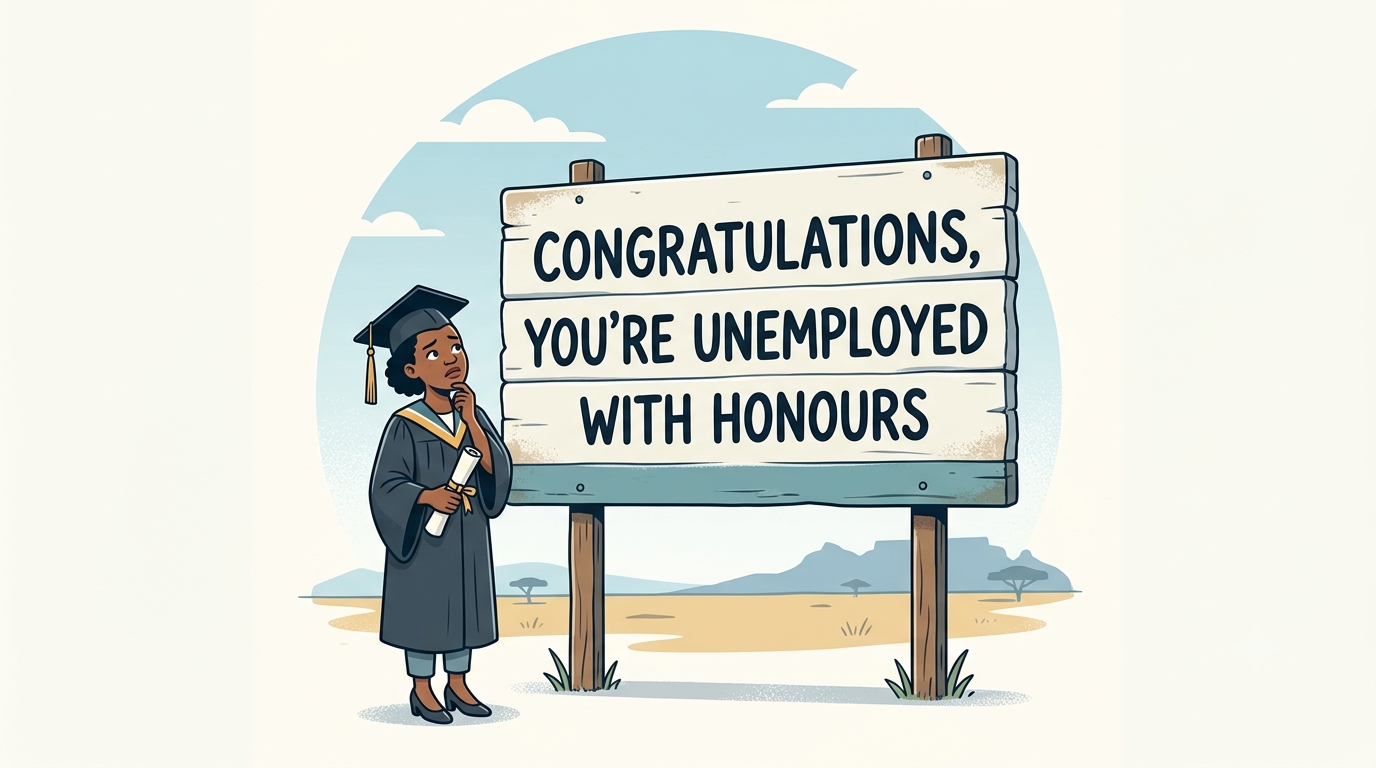
Picture the scene. Rush-hour traffic, a busy intersection somewhere in Cape Town or Johannesburg, taxis nudging past sedans. And there, standing on the pavement, is a young person in a collared shirt holding up a handwritten board. Not asking for change. Asking for a chance. The board lists a qualification, sometimes an internship, a phone number, and a plea that boils down to: please, someone, give me a job.
Now put that image next to what job hunting is supposed to look like in 2026. A jobseeker opens an app, uploads a CV, answers a string of screening questions about their "five-year salary expectations," verifies an email address, completes a personality assessment nobody asked for, and waits. And waits. Eventually, maybe, an automated message arrives thanking them for their interest and informing them that the position has been filled by someone else or, more often, nothing arrives at all.
Somewhere between those two pictures, a growing number of South Africans have quietly concluded that the second one isn't working, and the first one just might. Whether that's a clever hack of a broken system or a symptom of just how broken it's become is exactly the question worth sitting with.
Why are jobseekers taking their search to the streets?
Nobody wakes up dreaming of standing at a robot with a placard. This is a last resort dressed up as initiative, and understanding why people arrive at it means looking honestly at what's failed them before it.
Start with the scale of the problem. South Africa's official unemployment rate reached 32.7% in the first quarter of 2026, with the youth unemployment rate ,covering people aged 15 to 34 , at 45.8% (Stats SA, Quarterly Labour Force Survey, Q1 2026). Among the youngest jobseekers, aged 15 to 24, that figure climbs past 60%. These aren't abstract numbers. They describe millions of people who are actively searching for work and simply not finding it, no matter how many boxes they tick.
Then there's the specific frustration of the online application process, which manages to be both exhausting and strangely impersonal at the same time. You can spend forty minutes on a single application, re-entering information that was already on the CV you uploaded two screens earlier, only to receive a rejection generated by a system that never had a human read anything you wrote. Applying for work has become an act of faith in software you can't see and criteria you're never told.
Add to that the barriers that don't show up in job ads: no professional network to tap into, no family friend "who knows someone," limited data to keep submitting applications every day, an address that some algorithms quietly penalise, or simply the sheer number of other qualified people applying for the same forty positions. When every conventional door seems to lead to a waiting room, standing somewhere visible starts to look less like desperation and more like the only lever left to pull.
"What if I have already applied for hundreds of jobs?"
Then you already know the frustration that sits underneath this trend. Hundreds of applications with little to no response isn't a reflection of your worth or your effort, it's a reflection of how many people are competing for how few positions, and how much of the modern hiring process runs on automated filtering rather than a person actually reading what you sent. That doesn't mean the applications were pointless. It means the odds were never going to be kind, and it may be time to add a second or third strategy alongside the ones you've already tried.
Is this actually a new idea?
Here's an inconvenient truth for anyone tempted to call this a bizarre new trend: standing somewhere visible and making yourself known to potential employers is one of the oldest job-search strategies there is. Long before online applications existed, people got hired by walking into a business and asking if anyone was hiring, by being introduced through a neighbour, or by simply being the person a shop owner saw outside often enough to eventually offer a shift.
"Networking," as it's taught in career workshops today, is really a more polished, indoor version of the same instinct, put yourself where the right people might notice you, and make it easy for them to remember who you are. A LinkedIn connection request with a thoughtful note and a cardboard sign at a busy intersection aren't as different as they first appear. Both are, fundamentally, a bet that visibility creates opportunity. One just happens to require WiFi, and the other requires comfortable shoes.
Could standing on the street actually work?
Sometimes, yes, and the recent example of Lungelo Ndaba, a town planning graduate who stood at a Cape Town intersection with his qualifications and contact details on Youth Day 2026, shows why. A video of him was filmed by a local radio presenter, shared online, and amassed more than 5.8 million views within days, bringing him messages of support, job leads and renewed public attention to his search. Cases like his aren't isolated; similar moments involving graduates and jobseekers standing at intersections with handwritten boards have periodically gone viral in South Africa for close to a decade.
What makes it work, when it works, isn't really the sign, it's the human moment it creates, and the reach that moment gets once it's captured and shared. A recruiter scrolling LinkedIn sees a hundred profiles that look alike. A driver stuck at a red light sees one real person holding a piece of cardboard, and that has a way of cutting through in a manner an online application simply can't.
But it's worth being honest about what this actually is: an occasional, headline-worthy success story, not a reliable job-search method. For every viral moment that leads somewhere, there are countless people who stand at intersections and go home having been seen by hundreds of commuters and hired by none of them. Visibility is not guaranteed, and even when it happens, it isn't guaranteed to lead anywhere.
"Can standing beside a road really get you a job?"
It can, occasionally, and it has, but treat those stories as the exception that made the news, not the rule you should plan a job search around. The people whose stories go viral are the ones you hear about precisely because it's unusual. Most jobseekers standing at an intersection on any given Tuesday won't end up on the evening news.
The biggest problem: being visible is not the same as being employable
This is the part that gets lost in the feel-good version of these stories. A viral moment gets someone's attention. It does not complete the hiring process for them.
An employer who sees a compelling sign and decides to follow up will, in almost every real case, still need the basics: a CV, verifiable qualifications, references, relevant skills, and a conversation that confirms this is genuinely the right fit for the role. Public attention might get someone's name in front of a decision-maker faster than a stack of applications would have. It doesn't replace the interview, the background check, or the requirement that the person can actually do the job.
That's not a criticism of anyone standing at an intersection — it's simply a reminder that a sign is a foot in the door, not the whole building. Anyone using this approach needs a CV ready, references lined up, and a clear answer prepared for the obvious question the attention will bring: so what exactly can you do?
Could employers see this as initiative?
Reactions genuinely vary here, and it would be dishonest to pretend otherwise.
Some employers and hiring managers do read this kind of visible, direct approach as a sign of determination, proof that someone is willing to put themselves out there rather than passively waiting for an inbox to fill up. In an environment where "keen and available" candidates can be hard to distinguish from "lukewarm and browsing" ones, that kind of visible effort does register with some decision-makers as a point in someone's favour.
Others will feel differently, or simply won't know quite what to do with it. A road sign doesn't fit neatly into a standard hiring process, and not every company culture is set up to respond to something this informal, however genuine it is. And realistically, plenty of potential employers will simply never see the sign at all, they're not the ones driving past that particular intersection on that particular day.
"Will employers take someone seriously if they advertise themselves this way?"
Some will, some won't, and it depends heavily on the industry and the individual employer. What tends to matter most, regardless of the reaction, is what happens after the moment of attention, whether the person has a professional CV ready, communicates clearly, and can back up the sign with substance in the follow-up conversation.
The uncomfortable question: what does this say about the job market?
Step back from any single story, and a harder question sits underneath all of them: what does it mean when people start to feel that submitting a CV online simply isn't enough anymore?
It's worth being precise about what we actually know here. There is no national study measuring exactly how many South Africans are standing at intersections with employment signs, and it would be misleading to claim this is a scientifically documented mass movement rather than a series of individually striking, occasionally viral moments. What we can say with more confidence is the environment that makes this kind of desperation-driven creativity understandable in the first place.
Graduate unemployment itself has been rising, not just general unemployment. Recent reporting on Lungelo Ndaba's case cited Stats SA figures placing the graduate unemployment rate at around 12.2%, a smaller number than the headline rate, but still a meaningful one, given that a university qualification has traditionally been sold as close to a guarantee against unemployment (Stats SA, Quarterly Labour Force Survey; as reported by Briefly News, June 2026). When qualified, capable graduates with completed internships can't find entry-level roles through conventional channels, a sign at an intersection stops looking like an oddity and starts looking like a rational, if uncomfortable, response to a system that isn't delivering.
None of this means the job market has failed every individual equally, or that every unemployed person will end up at a robot with a placard. It means enough people are running out of conventional options that this has become a recognisable pattern rather than a one-off curiosity, and that alone is worth taking seriously.
Is it better than endlessly applying online?
"Better" depends entirely on what you're optimising for. Here's how the two approaches actually compare:
Traditional online job hunting offers scale, you can apply to dozens of positions across the country, or the world, without leaving your chair. It's also relatively low-risk and, for many industries, still the expected first step. Its weaknesses are just as real: a high risk of your application disappearing into an automated filtering system, minimal personal interaction, and long, often silent waits for a response that may never come.
Direct, public job hunting, standing somewhere visible, approaching businesses in person, holding a sign, offers something online applications rarely do: an actual human moment, and the possibility of reaching a decision-maker directly rather than an applicant-tracking system. It doesn't scale, though. You reach the people who happen to pass by, not the people best positioned to hire you for your specific field, and there's no guarantee the right person will ever see it.
Neither approach reliably outperforms the other on its own. The honest answer is that they solve different problems, and a job search that only uses one of them is leaving the other's advantages on the table.
"Is this better than applying for jobs online?"
Not better, different, and arguably complementary. Online applications reach scale that a sign never will. A public, visible approach can create the kind of personal moment an application form never will. Used together, they cover more ground than either does alone.
What are the risks of taking your job search to the streets?
This part deserves a straightforward, non-alarmist conversation, because the risks are real even if the intentions of most people trying this are entirely genuine.
Personal safety is the obvious starting point, standing near busy traffic for extended periods carries its own hazards, quite apart from the job search itself. There's also the risk of attracting the wrong kind of attention: people offering "opportunities" that turn out to be scams, multi-level marketing schemes dressed up as jobs, or vague promises that go nowhere once contact details have been handed over. South Africa has no shortage of fake job adverts already circulating on social media, and a public display of visible desperation can, unfortunately, make someone a more obvious target for exactly that kind of exploitation.
There's also a quieter risk worth naming: putting too much personal information on a public sign, a full ID number, a home address, banking details, is unnecessary and unsafe, regardless of how well-meaning the request for it might seem. And under real financial pressure, there's a genuine risk of accepting whatever offer comes first, even if it's unsuitable, underpaid or simply wrong for the person's skills, purely out of relief that someone, finally, responded.
None of this is a reason to dismiss the approach outright. It's a reason to go into it with eyes open.
Should jobseekers actually try it?
If someone chooses to try it, it should sit alongside a broader strategy, not replace one. Treat it as a single tool in a much larger kit that also includes:
- - Online applications and job portals, for scale and reach
- - LinkedIn and other professional networks, for visibility to recruiters actively searching
- - Recruitment agencies, particularly ones specialising in your field
- - Company career pages, for roles never advertised elsewhere
- - Referrals, still consistently one of the strongest predictors of getting hired
- - Career fairs and university alumni networks
- - Direct, professional approaches to specific employers you're genuinely interested in
"Should graduates consider unconventional job-search methods?"
Cautiously, yes provided the rest of the fundamentals are already in place. An unconventional method works best as an addition to a solid CV, a clear sense of what role you're targeting, and a genuine willingness to follow through once the attention arrives. It's a poor substitute for those fundamentals, but a reasonable supplement to them.
If you're going to do it, do it strategically
If someone does decide this is a route worth trying, a few practical adjustments make a real difference to how it lands.
Specificity matters more than volume of feeling. A sign reading "I NEED A JOB" communicates urgency but tells a passerby nothing useful. A sign reading "Computer Science Graduate Seeking Junior IT Opportunity" or "Qualified Electrician Seeking Employment" does something far more useful it tells the one person who might actually be able to help exactly what they're looking at, and whether it's relevant to them.
Beyond the sign itself, come prepared. Have a CV ready to send immediately if someone asks. Be able to explain clearly, in one or two sentences, what kind of work you're looking for and why you're qualified for it. And be deliberate about what personal information goes on public display a phone number or email is generally enough; there's no need for anything more sensitive than that.
"What should a jobseeker put on the sign?"
Keep it short, specific and professional: your qualification or trade, the kind of role you're after, and a way to contact you. Skip anything overly emotional or overly detailed the goal is to give a stranger enough information to know, at a glance, whether they can help.
"Could this approach damage someone's professional image?"
It's a fair concern, and the honest answer is: it depends on execution far more than on the strategy itself. A well-presented, specific, professional sign paired with a genuine qualification tends to read as resourceful. A vague, purely emotional appeal risks reading differently. Employers, like most people, respond to clarity and preparation, on a sign just as much as on a CV.
What WorkBase21 Thinks
We're not going to tell you this is a genius strategy every jobseeker should copy. We're also not going to roll our eyes at the people doing it. Both reactions miss the point.
Standing at an intersection with your qualifications on display takes a kind of courage that's easy to underestimate from behind a laptop. It also, undeniably, reflects a job market where plenty of qualified, capable people have exhausted the conventional options and are left improvising. Those two things are true at the same time, and neither cancels the other out.
Our honest view: treat this as one possible tool among many, not a replacement for the fundamentals of a structured job search — a strong CV, a clear target, active networking, and consistent follow-through. If it works for someone, genuinely, we're glad. If it doesn't, that's not a verdict on their effort or their worth. It's a reflection of how tight this market has become, and that's a much bigger conversation than any one person's sign can carry alone.
A final thought
So, back to that intersection. Someone standing there, sign in hand, while the traffic light cycles from red to green and back to red again.
It's tempting to read that image as either inspiring or tragic, and the truth sits somewhere less tidy than either option. It's a person doing something genuinely resourceful in response to a system that has, for a lot of people, stopped responding at all. Getting noticed, it turns out, was never really the hard part, plenty of people get noticed and go home with nothing more than a few hundred likes and a warm feeling from strangers. The hard part, same as it's always been, is turning that moment into an actual job: the CV, the interview, the reference check, the follow-up.
A cardboard sign might get you seen. What happens after that is still, stubbornly, up to the CV in your bag and the answers you give once someone actually stops the car.
References
- Statistics South Africa. "Quarterly Labour Force Survey, Q1: 2026." statssa.gov.za/publications/P0211/P02111stQuarter2026.pdf
- Statistics South Africa. "South Africa's Youth and the Labour Market in Q1 2026." statssa.gov.za/?p=19526
- News24. "Viral video turns Cape Town graduate's roadside sign into real job prospects" (19 June 2026). news24.com/southafrica/good-news/viral-video-turns-cape-town-graduates-roadside-sign-into-real-job-prospects-20260619-0473
- Cape {town} Etc. "Watch: Cape Town graduate's roadside sign opens unexpected doors" (19 June 2026). capetownetc.com/news/lungelo-ndaba-viral-video-job-opportunities/
- Briefly News. "'He's going to make it in life': Town planner graduate begging for a job on the street moves Mzansi" (17 June 2026). briefly.co.za/people/244416-s-life-town-planner-graduate-begging-a-job-street-moves-mzansi/