Why Some Graduates Get Hired Back-to-Back While Others With the Same Qualification Keep Getting Rejected
By WorkBase21
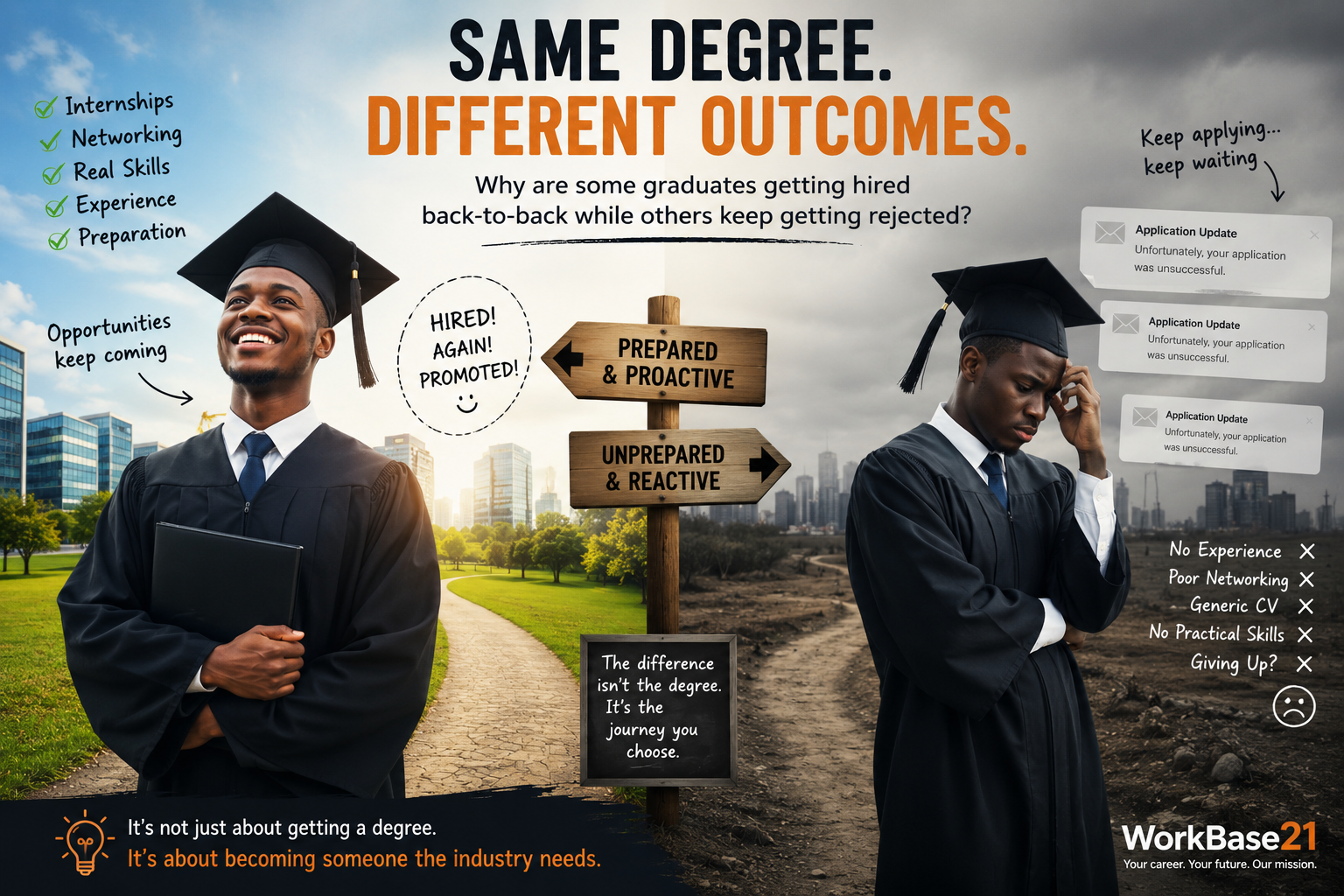
You and your friend studied the same degree.
You attended the same lectures. You survived the same assignments. You complained about the same difficult lecturer. You probably even wrote the same exam while wondering whether you had chosen the wrong career altogether.
Then graduation arrives.
Your friend gets an internship.
Then another opportunity.
Then a permanent job.
Then, somehow, they are posting “Excited to announce my new role…” on LinkedIn for the third time in two years.
Meanwhile, you are refreshing your inbox.
Nothing.
You apply for a position.
“Unfortunately, your application was unsuccessful.”
You apply for another.
Same story.
Eventually, you start asking yourself the uncomfortable question:
“What does my friend have that I don't?”
The answer is usually more complicated than simply saying that one graduate is “better” than another.
Two people can have exactly the same qualification and have completely different chances of getting hired.
South Africa's labour market is extremely competitive. The latest figures from Statistics South Africa show that the country's official unemployment rate reached 32.7% in the first quarter of 2026. At the same time, the labour market is not equally difficult for everyone. Education, experience, skills, location, field of study and other factors can significantly influence someone's chances of finding work.
So, why does one graduate seem to have a permanent job offer subscription while another is still waiting for the first interview?
1. The qualification is the same. The skills may not be.
This is probably one of the biggest misunderstandings about graduate employment.
A degree tells an employer that you completed a particular academic programme.
It doesn't necessarily tell them what you can actually do in a workplace.
Two graduates can both have a Bachelor of Commerce, for example, but one may have spent their final year learning Excel, analysing real datasets, building financial models, volunteering for an organisation and completing short industry projects.
The other may have focused almost entirely on passing modules.
Both have the same qualification.
But their CVs tell very different stories.
This is what is often described as a skills mismatch — where the skills people have don't perfectly match what employers need.
Stats SA has previously highlighted skills mismatch as one of the structural problems affecting South Africa's labour market.
And employers are not necessarily saying, “We don't want graduates.”
Sometimes they are saying:
“We need graduates who can contribute to the work we actually need done.”
That distinction matters.
2. Work experience has become the annoying chicken-and-egg problem
“Entry-level position.”
Sounds encouraging, right?
Then you read the requirements.
“Minimum two years' experience required.”
Wait.
It's an entry-level job.
Where exactly was the graduate supposed to obtain the two years?
This is one of the frustrations facing young job seekers.
Stats SA reported that in Q1 2025, 58.7% of unemployed young people reported having no previous work experience. That creates a difficult cycle: employers often want experience, but graduates need someone to give them that first opportunity before they can build it.
The Council on Higher Education has also discussed the traditional gap between university education and workplace experience, noting that higher education can provide a foundation while specialised workplace skills are often developed through practical experience.
This means a graduate who completed an internship, vacation programme, learnership, part-time job, volunteering opportunity or meaningful practical project may enter the recruitment process with an advantage.
Not because they have a better degree.
Because they have evidence that they can operate outside the classroom.
3. Some graduates understand how recruitment actually works
This one is uncomfortable.
You can be highly intelligent and still be terrible at job hunting.
Imagine two graduates with the same qualification.
Graduate A sends the same generic CV to every company.
Graduate B adjusts their CV according to the position, highlights relevant skills, writes a targeted application and makes sure their LinkedIn profile supports what their CV says.
Who is easier for the recruiter to understand?
Probably Graduate B.
Recruiters don't have unlimited time to investigate every applicant's potential.
Your application needs to make the connection fairly quickly:
“Here is what I studied. Here is what I can do. Here is what I have done. And here is why it relates to this position.”
That is why a graduate can have an impressive qualification but still struggle to communicate their value.
The problem isn't necessarily the qualification.
Sometimes the problem is how the qualification is presented.
4. Networking can create opportunities that job boards don't
This is another reason why graduates sometimes have dramatically different outcomes.
One person hears about an internship because they follow companies, attend career events, speak to lecturers, participate in professional communities or maintain relationships with people they met during university.
Another person only discovers the opportunity after it has already received hundreds of applications.
And yes, that can feel unfair.
But networking isn't necessarily about having a wealthy uncle who knows the CEO.
Sometimes it is much simpler.
A lecturer tells a student about an opportunity.
A former classmate shares a vacancy.
Someone they met during an internship recommends them.
A recruiter discovers their profile.
A professional remembers them six months later.
Suddenly, two graduates with the same qualification are standing at completely different starting lines.
5. Location matters more than many graduates realise
Let's say two graduates have identical qualifications.
One lives in Johannesburg and can attend interviews across Gauteng.
The other lives in a smaller town where opportunities in their field are limited.
Their qualifications are identical.
Their labour markets are not.
South Africa's employment opportunities are unevenly distributed geographically, and Stats SA has found differences in employment transitions across provinces.
This is particularly important for graduates who cannot easily relocate because of transport costs, family responsibilities or financial limitations.
Sometimes the problem isn't:
“There are no jobs for me.”
It is:
“There aren't enough jobs for me where I currently live.”
Those are two very different problems.
6. The degree itself can influence the odds
We also need to have an honest conversation about fields of study.
Not all qualifications lead to the same number of vacancies.
Stats SA's Q2 2025 data showed an unemployment rate of 12.2% among graduates, substantially below the national unemployment rate at the time. But even within the graduate population, employment prospects vary by field, experience and other characteristics.
This is why saying “I have a degree, therefore I should be employed” doesn't quite work.
A degree improves your position in the labour market, but it doesn't guarantee a vacancy exists for your particular specialisation.
There can be 5,000 graduates with a particular qualification and only a fraction of that number of suitable entry-level vacancies.
And unfortunately, the economy does not say:
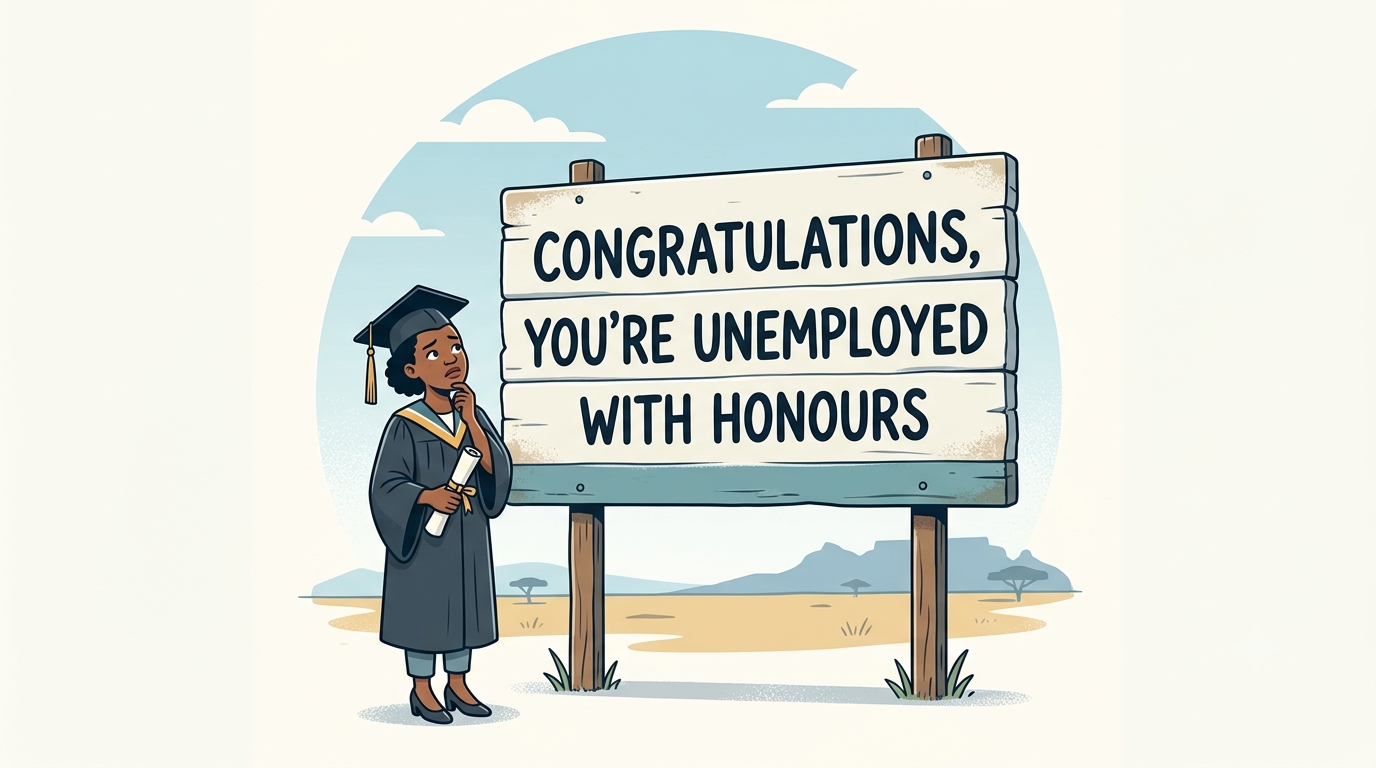
“Congratulations, you graduated. Here is your matching job.”
If only it did.
7. Some graduates start building their careers before graduation
This can create a huge difference.
Consider two students.
During university, Student A focuses entirely on academic marks.
Student B also studies seriously but spends some weekends building projects, volunteering, joining student organisations, doing freelance work, learning industry software or completing practical training.
Neither approach automatically makes someone better.
But by graduation, Student B may have something Student A doesn't:
a portfolio of evidence.
For a technology graduate, that could mean projects on GitHub.
For a marketing graduate, it could mean campaigns or content projects.
For a finance graduate, it could mean financial analysis projects.
For a design graduate, it could mean a portfolio.
For almost any field, there are ways to demonstrate what you can do beyond simply listing a qualification.
And when everyone has a degree, evidence becomes powerful.
8. Communication and other "soft skills" can quietly separate candidates
This is one of those things people don't like hearing.
You can be brilliant technically and still struggle during interviews.
Can you explain your thinking?
Can you work with other people?
Can you communicate clearly?
Can you describe a problem you solved?
Can you take feedback?
Can you demonstrate initiative?
These aren't always written as separate university modules, but employers frequently consider them when evaluating candidates.
Research on graduate employability in South Africa has similarly identified factors such as skills mismatch, limited labour demand and lack of work experience as contributors to graduate unemployment.
So sometimes the difference between two candidates isn't their marks.
It is their ability to demonstrate how those marks translate into workplace value.
9. Confidence can affect the interview — but confidence is not the same as competence
Here's another interesting one.
Some graduates walk into interviews thinking:
“Please, please, please give me this job.”
Others walk in thinking:
“Let me explain why I can do this job.”
The second mindset can make a difference.
But there is an important distinction.
Confidence doesn't mean pretending to know everything.
In fact, saying “I don't know, but here's how I would find out” can sometimes be a much stronger answer than inventing something impressive.
Employers aren't necessarily looking for someone who knows everything.
They want to see whether you can learn, think, communicate and solve problems.
10. Sometimes it really is luck
Let's not pretend everything is within the graduate's control.
It isn't.
Sometimes one graduate applies when a company has ten vacancies.
Another applies when the company has frozen hiring.
One gets an interviewer who likes their background.
Another gets rejected because the employer has already identified an internal candidate.
One happens to meet a recruiter at the right event.
Another sends 50 applications into the internet's mysterious black hole.
Timing matters.
Economic conditions matter.
Hiring budgets matter.
Company restructuring matters.
And sometimes, yes, luck matters.
This is important because graduates can easily turn unemployment into a judgement about their own worth.
Being unemployed does not automatically mean you are lazy, unintelligent or unemployable.
South Africa's labour market itself is extremely constrained. In Q1 2026, the number of unemployed people increased by 301,000 compared with the previous quarter, according to Stats SA.
There simply aren't enough suitable opportunities for everyone who wants one.
So, what does this mean for graduates?
It means the question shouldn't only be:
“Do I have the qualification?”
The better questions are:
“What can I actually do?”
“Can I prove it?”
“Do I have any practical experience?”
“Does my CV clearly communicate my strengths?”
“Am I applying for roles that genuinely match my skills?”
“Am I building professional connections?”
And perhaps the most important:
“What would make an employer choose me when 200 other people have a similar qualification?”
That last question can be uncomfortable.
But it can also be useful.
Because the goal isn't to become better than every graduate in the country.
The goal is to become a stronger candidate than you were six months ago.
The graduate job market isn't a simple meritocracy
This is probably the biggest lesson.
We often hear:
“If you work hard, you will succeed.”
Hard work matters.
Skills matter.
Qualifications matter.
Experience matters.
But so do economic conditions, opportunity, location, networks, timing and access.
That's why two graduates can work equally hard and experience completely different outcomes.
The graduate who gets hired three times in two years isn't necessarily three times more intelligent.
And the graduate who has been unemployed for two years isn't necessarily doing nothing.
The labour market is much more complicated than that.
As economist and analyst Bonke Dumisa recently argued in discussing South Africa's graduate unemployment problem, there is a significant mismatch between the graduates produced by the education system and some of the skills demanded by industry.
Another recent analysis from the Institute for Security Studies similarly points to practical experience, digital literacy and transferable skills such as communication and problem-solving as important parts of graduate employability.
So if your university friend has already landed their second job while you're still waiting for your first opportunity, don't immediately conclude that you're doing everything wrong.
But don't ignore the lesson either.
A qualification opens the door. What you bring through the door matters too.
And sometimes, unfortunately, you still need someone to actually open the door.
That's where employers, universities and government also have a role to play.
Graduates need opportunities to gain experience. Employers need to be realistic about entry-level requirements. Universities need stronger connections with industry. And policymakers need to focus on an economy capable of absorbing the growing number of qualified young people.
Because telling a graduate to “get experience” when every entry-level vacancy asks for experience is not exactly a brilliant economic strategy.
It's basically telling someone:
“You need a key before we can give you the key.”
And that is a problem worth fixing.
Final thought from WorkBase21
If you're currently unemployed after graduating, don't let someone else's LinkedIn announcement convince you that your own career is finished.
Their timeline is not your timeline.
But while waiting for the opportunity, keep improving the things you can control: your skills, portfolio, CV, interview ability, professional network and knowledge of the industries you're targeting.
The job market may be difficult.
That doesn't mean you stop preparing for the moment it finally says:
“Congratulations, you're hired.”
This article is intended for general career information and reflects labour-market trends and publicly available research. Individual employment outcomes vary considerably by field, location, experience and personal circumstances.